Showing posts with label videos. Show all posts
Showing posts with label videos. Show all posts
Monday, December 7, 2009

Thursday, December 3, 2009
More With the Creepy Guy
Here are some recommended videos on the design argument from Closer to Truth:

- Philosopher Richard Swinburne likes the design argument. (Part 2 of his interview is here.)
- Philosopher Bede Rundle is less convinced.
- Philosopher Colin McGinn tackles the issue of fine-tuning.
Tuesday, December 1, 2009
Her Stroke of Insight
This is indirectly related to what we're discussing in class. It shows the degree to which our mind actively constructs our understanding of reality around us. Here's neuroscientist Jill Bolte Taylor's TED talk on her experience of having a stroke:
Bolte Taylor wrote a whole book on her experience. It's available in most book stores. Here's a more detailed audio interview with her.
I love TED talks. Here are some of my other favorites:
Bolte Taylor wrote a whole book on her experience. It's available in most book stores. Here's a more detailed audio interview with her.
I love TED talks. Here are some of my other favorites:
Saturday, November 28, 2009
Design in the Mind's Eye
Here's an interesting approach to explaining the seeming complexity, order, and functionality of the universe: maybe it's all in our mind.
Psychologist Paul Bloom argues that we see intentional design and patterns too much... including in things that are actually random. So things that seem so fine-tuned and unlikely from our perspective might not actually be. Here's a video dialogue on this topic:
Bloom has two great books (Descartes' Baby and How Children Learn the Meaning of Words) on how our minds develop from early childhood on.
Tuesday, October 27, 2009
Why Is Anything Anything?
The website Closer to Truth has a ton of short interviews with modern-day philosophers (and other smart people) on their thoughts about god. For instance, there's a whole section on the cosmological argument titled "Why Is There Something Rather Than Nothing?" Here are some videos from that section:
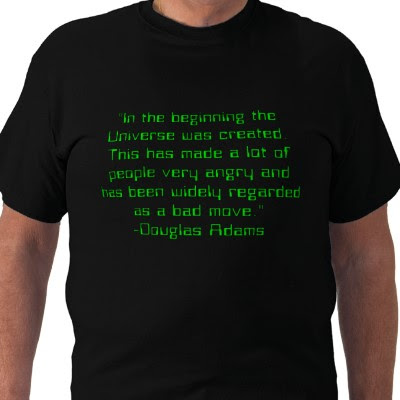
- Theist John Leslie says God best explains why there is something.
- Theist Peter van Inwagen believes in God, but doesn't like this arg.
- Atheist Colin McGinn thinks it's a meaningless question.
- Physicist Steven Weisberg says we should wait for science's answer.
Saturday, October 10, 2009
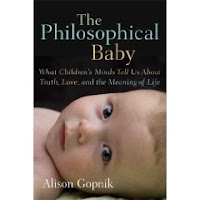
The Philosophical Baby
Monday, September 21, 2009
DaffyDuctive? Really, Sean?
Here's a few dumb things about the arguments we discussed in class this week. First, inductive arguments. Here's a video of comedian Lewis Black describing his failure to learn from experience every year around Halloween:
And here's a stick figure comic with a bad inductive argument. What's bad about it? (Let us know in the comments!)

Finally, in honor of abductive arguments, here's a dinosaur comic murder mystery.

And here's a stick figure comic with a bad inductive argument. What's bad about it? (Let us know in the comments!)
Finally, in honor of abductive arguments, here's a dinosaur comic murder mystery.
Thursday, September 10, 2009
Evaluating Deductive Args
Here are the answers to the handout on evaluating deductive arguments that we did as group work in class. Perhaps I should have titled the handout "So Many Bad Args!"
1) All kangaroos are marsupials.
All marsupials are mammals.
All kangaroos are mammals.
Bush was either a great prez or the greatest prez.
Bush wasn’t the greatest prez.
Bush was a great prez.
Sean is a person.
Sean is funny.
Some email forwards are false.
Some annoying things are false.
All bats have wings.
All mammals have wings.
All bearded people are mean.
Some dads are mean.
All boring things are taught by Sean
This class is taught by Sean.
All humans are mammals.
All students in here are humans.
All wasps are insects.
All insects are scary.
All hornets are scary.
All humans are shorter than 10 feet tall.
All students in here are shorter than 10 feet tall.
Sean is singing right now.
Students are cringing right now.
Sean isn't singing right now.
Students aren't cringing right now.
Students aren't cringing right now.
Sean isn't singing right now.
Students are cringing right now.
Sean is singing right now.
1) All kangaroos are marsupials.
All marsupials are mammals.
All kangaroos are mammals.
P1- true2) (from Stephen Colbert)
P2- true
structure- valid
overall - sound
Bush was either a great prez or the greatest prez.
Bush wasn’t the greatest prez.
Bush was a great prez.
P1- questionable ("great" is subjective)3) Some people are funny.
P2- questionable ("great" is subjective)
structure- valid (it's either A or B; it's not A; so it's B)
overall- unsound (bad premises)
Sean is a person.
Sean is funny.
P1- true (we might disagree over who specifically is funny, but nearly all of us would agree that someone is funny)4) All email forwards are annoying.
P2- true
structure- invalid (the 1st premise only says some are funny; Sean could be one of the unfunny people)
overall- unsound (bad structure)
Some email forwards are false.
Some annoying things are false.
P1- questionable ("annoying" is subjective)5) All bats are mammals.
P2- true
structure- valid (the premises establish that some email forwards are both annoying and false; so some annoying things [those forwards] are false)
overall - unsound (bad first premise)
All bats have wings.
All mammals have wings.
P1- true6) Some dads have beards.
P2- true (if interpreted to mean "All bats are the sorts of creatures who have wings.") or false (if interpreted to mean "Each and every living bat has wings," since some bats are born without wings)
structure- invalid (we don't know anything about the relationship between mammals and winged creatures just from the fact that bats belong to each group)
overall- unsound (bad structure)
All bearded people are mean.
Some dads are mean.
P1- true7) This class is boring.
P2- questionable ("mean" is subjective)
structure- valid (if all the people with beards were mean, then the dads with beards would be mean, so some dads would be mean)
overall- unsound (bad 2nd premise)
All boring things are taught by Sean
This class is taught by Sean.
P1-questionable ("boring" is subjective)8) All students in here are mammals.
P2- false (nearly everyone would agree that there are some boring things not associated with Sean)
structure- valid
overall- unsound (bad premises)
All humans are mammals.
All students in here are humans.
P1- true9) All hornets are wasps.
P2- true
structure- invalid (the premises only tell us that students and humans both belong to the mammals group; we don't know enough about the relationship between students and humans from this; for instance, what if a dog were a student in our class?)
overall- unsound (bad structure)
All wasps are insects.
All insects are scary.
All hornets are scary.
P1- true!10) All students in here are humans.
P2- true
P3- questionable ("scary" is subjective)
structure- valid
overall- unsound (bad 3rd premise)
All humans are shorter than 10 feet tall.
All students in here are shorter than 10 feet tall.
P1- true11) If Sean sings, then students cringe.
P2- true!
structure- valid (same structure as arg #1)
overall- sound
Sean is singing right now.
Students are cringing right now.
P1- questionable (since you haven't heard me sing, you don't know whether it's true or false)12) If Sean sings, then students cringe.
P2- false (I'm not singing now!)
structure- valid
overall- unsound (bad premises)
Sean isn't singing right now.
Students aren't cringing right now.
P1- questionable (again, you don't know)13) If Sean sings, then students cringe.
P2- true
structure- invalid (from premise 1, we only know what happens when Sean is singing, not when he isn't singing; students could cringe for a different reason)
overall- unsound (bad 1st premise and structure)
Students aren't cringing right now.
Sean isn't singing right now.
P1- questionable (again, you don't know)14) If Sean sings, then students cringe.
P2- true
structure- valid
overall- unsound (bad 1st premise)
Students are cringing right now.
Sean is singing right now.
P1- questionable (again, you don't know)Also, here's Tiffany's big hit:
P2- false
structure- invalid (from premise 1, we only know that Sean singing is one way to guarantee that students cringe; just because they're cringing doesn't mean Sean's the one who caused it; again, students could cringe for a different reason)
overall- unsound (bad premises and structure)
Sunday, September 6, 2009
Definitions of "Philosophy"
Here are some videos on the definitions of the word "philosophy" that we discussed in class. First, the Bobby Brown definition: Nothing says "philosophy as a worldview" like 1988 Bobby Brown.
Bobby Brown - My Prerogative
Now for the 3-year-old definition. Here's comedian Louis CK's take on the broad, fundamental questions kids ask.
Louis CK - Why?
And here's what springs to my mind when I think about doing philosophy:

Subscribe to:
Posts (Atom)
